
Indoor Cat Enclosure: The Complete Guide to Safe, Enriching Spaces (2026)
Direct Answer
The best indoor cat enclosure gives your cat safe outdoor access, vertical climbing space, and mental stimulation without escape risk. Size, material, and attachment method matter most. A minimum 6×6×6 ft enclosure works for one cat. Top picks span window catios, freestanding playpens, and full outdoor tunnels — budget $80–$800 depending on scale and permanence.
Table of Contents
Luna spent her first four years staring through the glass at birds she could never reach. I thought keeping her inside was enough — safe from cars, predators, and disease.
What I missed was the cost of that safety. Chronic understimulation in indoor cats shows up as overgrooming, aggression, weight gain, and a kind of low-grade restlessness that no amount of toy rotation fixes completely.
A well-designed indoor cat enclosure changed that. Not by giving Luna the outdoors — but by giving her controlled access to it. The sights, sounds, smells, and textures of outside filtered through a structure she could enter and exit safely.
This guide covers every enclosure type, what each one actually delivers, and how to choose the right setup for your home, budget, and cat’s personality.
Quick Comparison Table
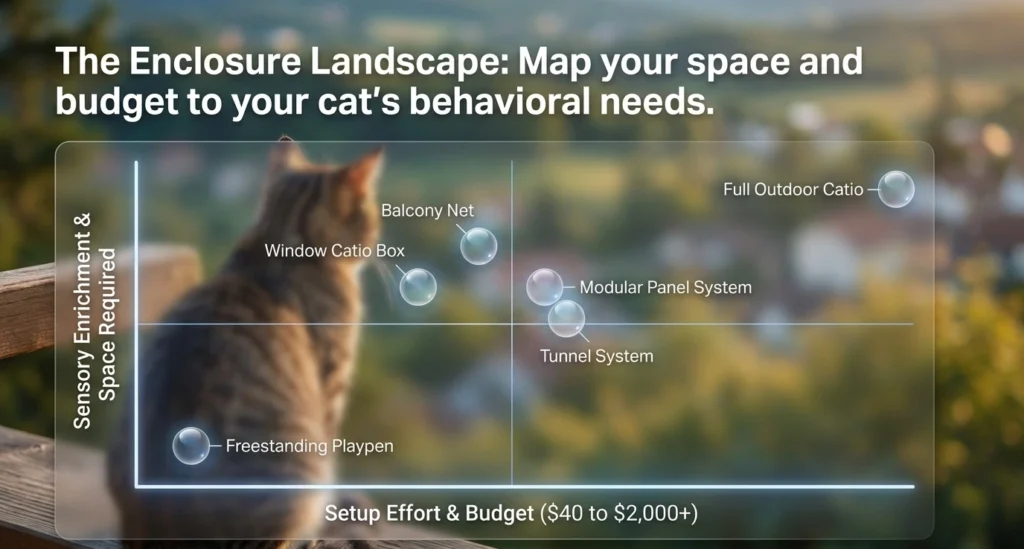
| Type | Space Needed | Best For | Assembly | Price Range | Enrichment Value |
|---|---|---|---|---|---|
| Window catio box | Zero floor space | Apartments, renters | Easy — no tools | $80–$250 | High — outdoor sensory access |
| Freestanding playpen | Small yard or patio | Budget, temporary | Easy — 10 min | $40–$150 | Medium — limited vertical space |
| Tunnel system | Existing outdoor space | Multi-cat, active cats | Moderate | $150–$400 | Very high — exploration range |
| Full outdoor catio | Yard or deck space | Permanent setups | Hard — DIY or pro | $300–$2,000+ | Maximum — natural environment |
| Indoor room divider enclosure | Interior room | Bad weather, kittens | Easy | $60–$180 | Medium — enrichment depends on setup |
| Balcony enclosure net | Balcony access | Apartment dwellers | Moderate | $100–$300 | High — elevation + fresh air |
| Modular panel system | Flexible space | Renters, trial setups | Easy — reconfigurable | $120–$500 | High — customizable |
Why Indoor Cats Need More Than Four Walls
Here is the part most cat care guides skip entirely.
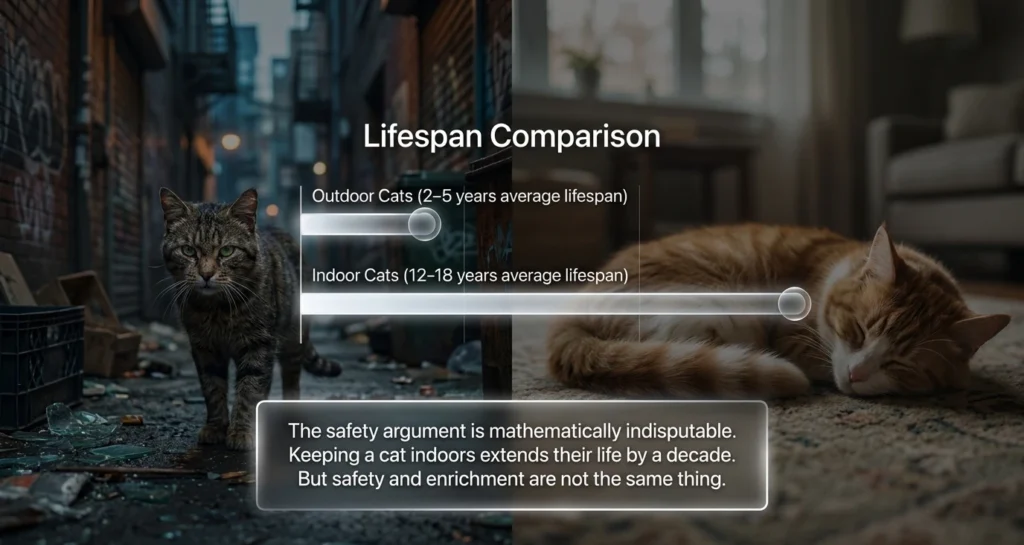
Keeping a cat indoors extends their life. The average outdoor cat lives 2–5 years. The average indoor cat lives 12–18 years. That data is not ambiguous and the safety argument for indoor living is solid.
But safety and enrichment are not the same thing. A cat kept safe inside four unchanging walls, with the same toys rotated weekly and the same view out the same window, is a cat living below their cognitive and behavioral capacity.
Cats are sensory hunters. Their nervous systems are built to process a continuous stream of novel smells, sounds, movement patterns, and textures. In the wild, that stream is constant. Inside a standard home, it is severely limited — the same smells, the same sounds, the same visual field every single day.
The behavioral consequences are well-documented. Chronic understimulation in indoor cats correlates with increased rates of overgrooming, redirected aggression, stress-related urinary issues, obesity from inactivity, and a form of learned helplessness that manifests as excessive sleeping and disengagement from play.
An enclosure does not solve all of that. But it introduces the single most powerful enrichment variable available to an indoor cat — controlled access to the sensory world outside their walls. Fresh air. Bird sounds. Grass textures. Seasonal smells. Moving insects. These inputs engage the feline nervous system at a level that no manufactured toy or puzzle feeder can replicate.
The Four Non-Negotiables for Any Cat Enclosure
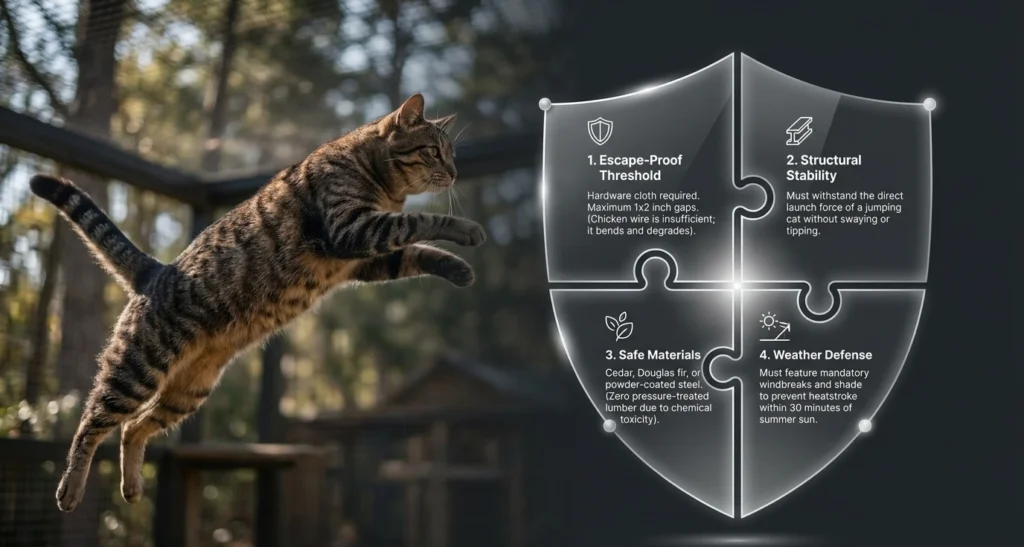
Before the product breakdown, here is my evaluation framework — the criteria I apply to every enclosure I review or recommend.
Escape-proof construction. This is the threshold requirement. Any gap larger than 2 inches in wire mesh or panel systems is a potential escape point for a determined or small cat. Hardware cloth with openings no larger than 1×2 inches is the standard I use. Chicken wire is insufficient — it degrades, bends, and can be pushed open by a motivated cat. Welded wire or powder-coated steel panels are the baseline for any permanent installation.
Structural stability. An enclosure that sways, tips, or shifts when a cat launches themselves from an elevated platform will be abandoned after one bad experience — and potentially cause injury. Every connection point, anchor, and support beam should be tested with direct force before your cat uses the structure.
Safe materials. Avoid pressure-treated lumber in any enclosure your cat will contact directly — the chemical treatment used in most outdoor-rated wood includes compounds that are harmful with sustained exposure. Cedar and Douglas fir are the appropriate natural wood choices. For metal components, powder-coated steel or aluminum are the safe options. Raw galvanized wire has zinc coating that can cause toxicity with prolonged contact.
Weather and temperature consideration. An enclosure your cat can access freely needs shade in summer and wind protection in winter. An enclosed space in direct summer sun can reach temperatures dangerous to cats within 30 minutes. Any enclosure without a shaded section should have access restricted to cooler parts of the day.
Types of Indoor Cat Enclosures — What Each One Actually Delivers
Window Catio Box
The window catio is the highest enrichment-per-square-foot option available to apartment dwellers and renters who cannot modify outdoor spaces.
A window catio box mounts directly to an existing window frame — typically secured with tension brackets that require no drilling and leave no permanent marks. The box extends outward from the window, creating a three-dimensional enclosed space your cat can enter through the open window while you maintain the window screen as a secondary barrier.
The sensory access is genuine. Fresh air, birdsong, rain sound, seasonal temperature variation, and visual movement all come through the mesh walls of the enclosure. For a cat that has lived exclusively with filtered indoor air and double-glazed visual access, the difference is immediate and observable — increased alertness, more active investigation behavior, and noticeably reduced indoor restlessness.
Sizes range from compact 16×24 inch single-cat boxes to larger 36×36 units that accommodate multiple cats and a small platform. The compact versions are genuinely apartment-compatible and most install in under 20 minutes.
Best for: Renters, apartment dwellers, any home with accessible windows and no yard access.
One honest note: Window catio boxes require a window that opens outward or slides horizontally. Casement windows that open on a hinge are not compatible with standard bracket-mount systems.
Freestanding Playpen Enclosure
The freestanding playpen — a collapsible, panel-based enclosure typically 4–6 feet in diameter — is the fastest, cheapest, and most flexible enclosure option available.
Setup takes under ten minutes with no tools. The enclosure folds flat for storage. It can be positioned on a patio, balcony, deck, or indoor room depending on weather and your cat’s supervised access needs.
The limitation is vertical space. Most freestanding playpens reach 36–48 inches in height — insufficient for cats who want to climb and elevated observation points. Adding a cat tree or elevated platform inside the enclosure addresses this, but the fundamental format is more floor-space than vertical territory.
For a first enclosure, a budget trial, or a temporary supervised outdoor session solution, the freestanding playpen is the right starting point. For cats who need genuine territory and vertical enrichment, it is a stepping stone rather than a destination.
Best for: Budget-conscious owners, renters, cats being introduced to outdoor access for the first time.
Tunnel System
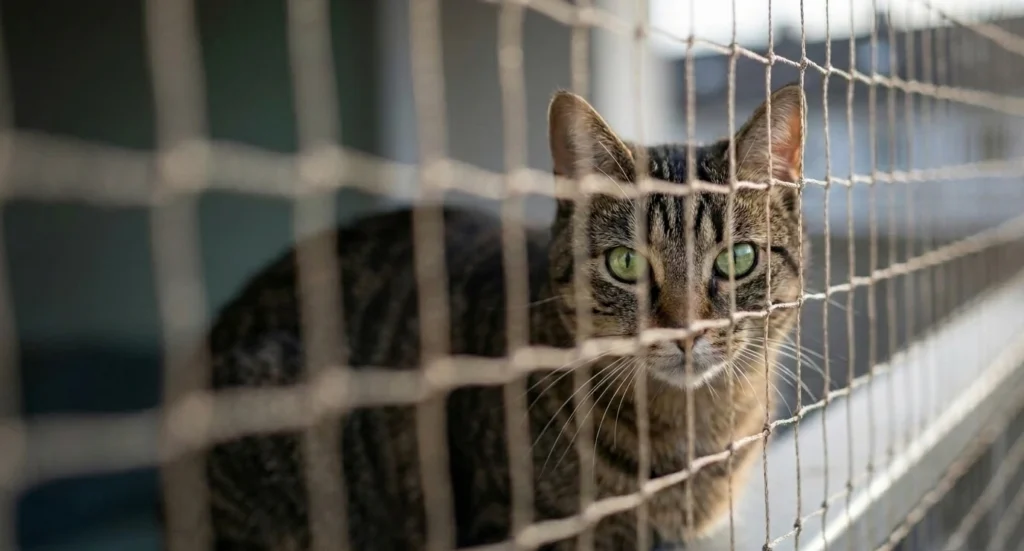
Tunnel systems — flexible mesh corridors that connect the interior of the home to an outdoor enclosure, or connect multiple outdoor enclosure zones — are the most enrichment-dense option for cats that respond to exploration rather than static elevation.
A cat that enters a tunnel system encounters changing smells, sounds, and surfaces along the entire length of the route. The tunnel format mimics the movement patterns of a cat on a hunting path — sustained movement through novel environmental territory — which engages predatory behavioral circuits in a way that a static enclosure cannot.
Tunnels are modular by design. A basic 10-foot section can be extended with additional connectors over time, eventually creating a multi-point outdoor circuit. The starting investment is modest — typically $150–$250 for a basic tunnel plus one destination enclosure — and the system scales with your budget.
Best for: Highly active indoor cats, multi-cat homes where individual cats benefit from separate exploration routes, owners willing to build incrementally.
Full Outdoor Catio
A full outdoor catio — a purpose-built enclosed structure attached to the home or freestanding in the yard — is the highest-investment and highest-enrichment option on this list.
A properly built catio functions as an outdoor room for your cat. Climbing structures, elevated platforms, grass or garden access, weather protection, and direct connection to the home through a cat door or window passage — all within a structure that eliminates escape and predator risk entirely.
The construction standard matters enormously. Hardware cloth over chicken wire. Cedar framing over pressure-treated lumber. Concrete footings or weighted base plates over unsecured panel systems. A catio built to lower standards deteriorates within two to three seasons and creates escape risks that a properly built structure eliminates permanently.
DIY catio builds using standardized plans — widely available from cat welfare organizations — typically run $300–$600 in materials for a 6×8 ft structure. Professional installation for a comparable structure runs $800–$2,000 depending on region and complexity.
Best for: Homeowners with yard or deck access who want a permanent, maximum-enrichment outdoor solution.
Balcony Enclosure Net
For apartment dwellers with balcony access, a properly installed balcony net system converts existing outdoor space into safe cat territory without structural modification.
Balcony netting installs using tension cable systems that attach to existing railings and overhead structure. The mesh — typically 1.5–2 inch knotted polyethylene or nylon — creates a full enclosure around the balcony perimeter.
The installation requires precise measurement and correct tensioning to be genuinely escape-proof. Gaps at corners and connection points are the primary failure mode — these require additional securing with zip ties or secondary mesh panels. A correctly installed balcony net is reliable. An incorrectly installed one is a false security measure that can result in a cat fall from height.
Professional installation is worth the cost for balconies above the second floor. DIY installation is appropriate for ground-level or first-floor balconies where a gap or failure is recoverable.
Best for: Apartment dwellers with balcony access, cats that need significantly more space than a window catio box provides.
Modular Panel System
Modular panel enclosures — interlocking wire or mesh panels in standardized sizes — offer the most flexible configuration of any enclosure type. The panels connect using clip or pin systems, allowing you to create custom footprints, add sections over time, and reconfigure entirely when you move.
For renters who want a permanent-feeling enclosure without permanent installation, the modular panel system is the practical solution. The structure can be as small as a 4×4 corner enclosure or as large as a full-room divider with multiple zones.
Panel quality varies significantly. The threshold standard is 16-gauge welded wire with powder coating — lighter gauge panels flex, develop stress fractures at connection points, and eventually fail under the repeated weight-bearing of cats launching from elevated positions.
Best for: Renters, owners who want reconfigurable setups, trial users building toward a permanent catio.
Find Your Cat’s Right Enclosure
🌿 Purreats Enclosure Finder
Which cat enclosure fits your home?
Answer 3 questions — get a matched enclosure type with a setup checklist.
1 of 3 — What type of home do you live in?
2 of 3 — How many cats need access to the enclosure?
3 of 3 — What is your budget range?
Setup checklist
Getting Your Cat to Use a New Enclosure
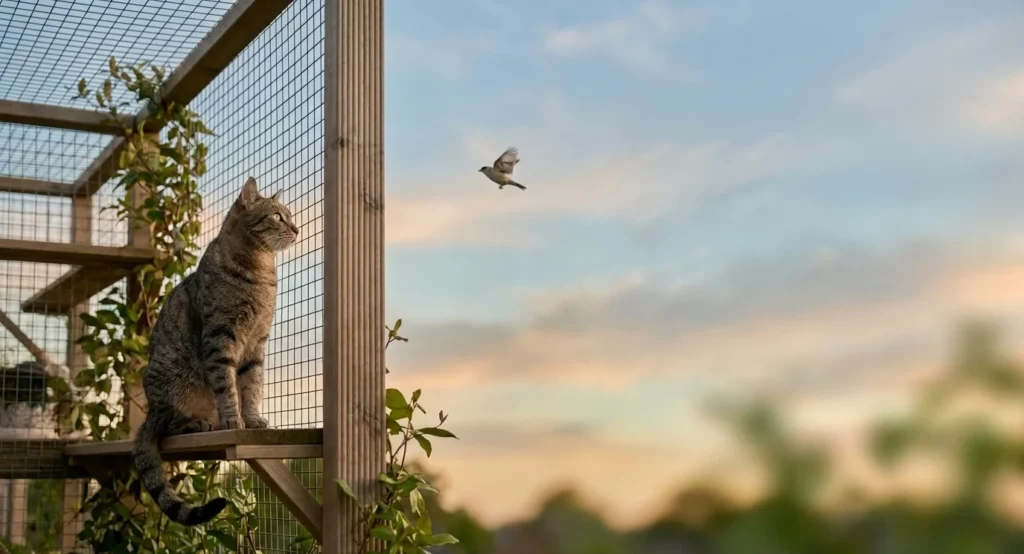
The most common reason a new enclosure goes unused is introduction speed — not the enclosure itself.
Cats do not voluntarily enter unfamiliar enclosed spaces quickly. An enclosure smells wrong, looks different, and represents unknown territory. That triggers avoidance, not exploration, in most cats on first encounter.
The introduction sequence that consistently works takes seven to ten days.
Days one and two: Place the enclosure in its final position but leave it closed. Allow your cat to sniff, rub against, and walk around the exterior at their own pace. Do not encourage entry.
Days three and four: Open one access point. Place a single treat just inside the entry — not deep inside, just at the threshold. Leave the area entirely while your cat investigates.
Days five and six: Move the treat slightly deeper inside. Add a piece of worn clothing inside the enclosure. The familiar scent signals safety in a novel space.
Days seven onward: Allow full access. For outdoor enclosures, supervise the first three sessions before transitioning to unsupervised access.
Never carry your cat into the enclosure and place them inside. Forced entry creates an avoidance association that can take weeks to reverse. The entire introduction process depends on the cat choosing entry on their own terms.
Key Takeaways
- Indoor cat enclosures address chronic understimulation — the single most underaddressed welfare issue for permanently indoor cats
- Escape-proof construction requires hardware cloth with maximum 1×2 inch openings — chicken wire is not adequate for any permanent installation
- Apartment dwellers have genuine options — window catio boxes and balcony net systems deliver real outdoor sensory access without structural modification
- Multi-cat enclosures need a minimum of one more exit point than you have cats to prevent territorial blocking
- Never use pressure-treated lumber in any enclosure — cedar and Douglas fir are the safe natural wood alternatives
- Introduction takes seven to ten days of patient, force-free exposure — rushing the process creates avoidance that delays actual use by weeks
Start Here This Week
- Use the interactive tool above to identify the right enclosure type for your home setup and cat count
- Identify your installation point — window, wall, yard, or balcony — before purchasing any enclosure
- Check mesh gauge on any product you consider — 16-gauge welded wire minimum for panels, 1×2 inch maximum opening for mesh
- Begin the seven-day introduction sequence the day the enclosure arrives — not after you feel settled with the setup
- Add one bird feeder or wind chime within sensory range of the enclosure in week two — external movement and sound doubles enrichment value
Related on Purreats: Best Dry Cat Food for Indoor Cats · Best Cat Food for Indoor Cats · Purina Indoor Cat Food · Whiskas Temptations Indoor Care Chicken Treats .How to Read a Cat Food Label