Whiskas Temptations Indoor Care Chicken Treats: Honest Review (2026)
Direct Answer
whiskas temptations indoor care chicken flavor cat treats are safe for occasional use — under 2 calories each, AAFCO-formulated, and legitimately popular with cats. The first ingredient is chicken by-product meal and the formula contains ground corn and wheat. They work for hairball support at a functional level, but 10+ treats per day eats significantly into your indoor cat’s calorie budget.
Table of Contents
If you own an indoor cat, there is a good chance you have shaken that crinkly yellow bag at least once. whiskas temptations indoor care chicken flavor cat treats are one of the best-selling cat treats in North America — and cats go absolutely feral for them.
But the questions I get from Purreats readers are always the same: Are they actually safe? Are they good for indoor cats specifically? And how many is too many?
The short answers: yes, they’re safe in moderation. The “indoor care” positioning is partly marketing. And the calorie math matters more than most cat owners realize.
I went through the full ingredient panel, broke down the guaranteed analysis, calculated the real calorie impact, and compared Temptations Indoor Care against the best alternatives on the market. Here is everything you need to know before you open that bag.
Quick Comparison Table — Temptations Indoor Care vs. Top Cat Treat Alternatives
| Product | First Ingredient | Cal/Treat | Hairball Support | Grain-Free | Price/oz |
|---|---|---|---|---|---|
| Temptations Indoor Care Chicken | Chicken By-Product Meal | ~2 cal | ✅ Cellulose + beet pulp | ❌ | ~$0.85 |
| Temptations Classic Chicken | Chicken By-Product Meal | ~2 cal | ❌ | ❌ | ~$0.80 |
| Greenies Feline Treats | Chicken | ~1.25 cal | ✅ Natural fiber | ❌ | ~$1.40 |
| PureBites Chicken Freeze-Dried | Chicken breast | ~1 cal | ❌ | ✅ | ~$2.20 |
| Churu Chicken Lickable Treats | Chicken | ~7 cal/tube | ❌ | ✅ | ~$1.10 |
| Zuke’s Lil’ Links Chicken | Chicken | ~3 cal | ❌ | ❌ | ~$1.30 |
| Vital Essentials Freeze-Dried Chicken | Chicken breast | ~1 cal | ❌ | ✅ | ~$2.50 |
💡 Sarah’s Note: At ~2 calories per treat, Temptations Indoor Care is among the lowest calorie-per-treat options — but volume adds up fast. 15 treats = ~30 calories, which is up to 15–18% of an average indoor cat’s daily 170–220 calorie budget.
What’s Actually Inside: The Full Ingredient Breakdown
Let’s start at the beginning — the ingredient panel.
Whiskas Temptations Indoor Care Chicken Flavor — Full Ingredient List:
Chicken By-Product Meal, Animal Fat (Preserved with Mixed Tocopherols), Ground Corn, Wheat Flour, Dried Meat By-Products, Brewers Rice, Powdered Cellulose, Natural Flavors, Plain Dried Beet Pulp, Corn Gluten Meal, Potassium Chloride, Choline Chloride, Salt, Taurine, DL-Methionine, Calcium Carbonate, Vitamin E Supplement, Zinc Sulfate, Mixed Tocopherols, Citric Acid, Ferrous Sulfate, Copper Sulfate, Vitamin A Acetate, Niacin Supplement, Vitamin B12 Supplement, Riboflavin Supplement, Rosemary Extract, Manganese Sulfate, Thiamine Mononitrate, D-Calcium Pantothenate, Pyridoxine Hydrochloride, Vitamin D3 Supplement, Biotin, Potassium Iodide, Folic Acid.
Now let’s walk through what matters.
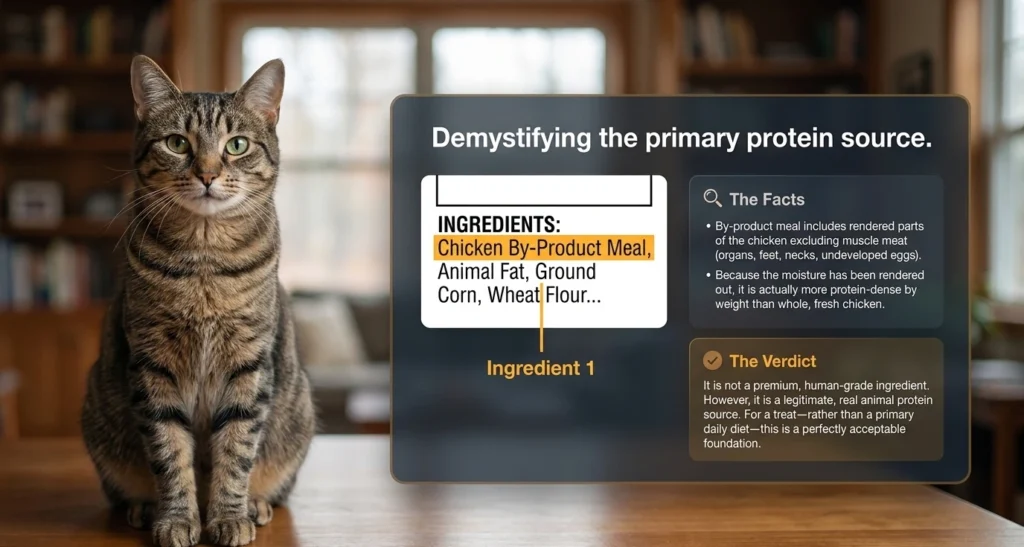
Ingredient 1: Chicken By-Product Meal
This is the primary protein source. Chicken by-product meal includes processed parts of the chicken that are not the breast, thigh, or whole muscle meat — organs, feet, necks, and undeveloped eggs are common components. It is not the same as named whole chicken, but it is a legitimate, high-protein ingredient. By-product meal is actually more protein-dense by weight than whole muscle chicken because the moisture has been rendered out.
The honest verdict: it’s not premium, but it is a real animal protein source. For a treat — not a primary food — this is acceptable.
Ingredient 3: Ground Corn
Corn shows up third. Cats have a very limited ability to metabolize corn-based carbohydrates. In a primary food, this is a significant problem. In a treat fed at 5–10 pieces per day, the total corn volume is small enough that it is not a serious concern for healthy cats.
Ingredients 7 & 9: Powdered Cellulose + Beet Pulp
This is the “indoor care” and hairball support claim made tangible. The formula uses two fiber sources:
- Powdered cellulose — insoluble fiber that adds bulk to stool to physically move ingested fur through the GI tract
- Beet pulp — a mixed soluble/insoluble fiber with better digestibility than cellulose alone
Using both is better than cellulose alone. The combination provides a more balanced fiber profile than you find in many single-fiber treat formulas.
What’s Missing: No Artificial Colors or Dyes
One meaningful positive — unlike the original Purina Cat Chow Indoor dry food, Temptations Indoor Care contains no artificial dyes. No Red 40, no Blue 2, no Yellow 5. For a treat that competes in the same budget tier, this is a genuine differentiator.
The Guaranteed Analysis — Nutrition by the Numbers
| Nutrient | As-Fed % | Dry Matter Basis |
|---|---|---|
| Crude Protein | 30% (min) | ~34.1% DMB |
| Crude Fat | 17% (min) | ~19.3% DMB |
| Crude Fiber | 8.5% (max) | ~9.7% DMB |
| Moisture | 12% (max) | — |
DMB Calculation: Moisture = 12%, so dry matter = 88%
- Protein DMB = 30 ÷ 88 × 100 = 34.1%
- Fat DMB = 17 ÷ 88 × 100 = 19.3%
For a treat, these numbers are acceptable. Protein at 34% DMB is lower than ideal for a primary food, but treats are not meant to be primary nutrition. The higher fat at 19.3% DMB is partly why cats find them so irresistible — fat is a powerful palatability driver.petsmart+1
The fiber ceiling at 8.5% (max) is higher than standard treats, which reflects the hairball-control function. More fiber in a treat means slightly more bulk per piece, which is the intended mechanism.
The “Indoor Care” Claim — What It Actually Means
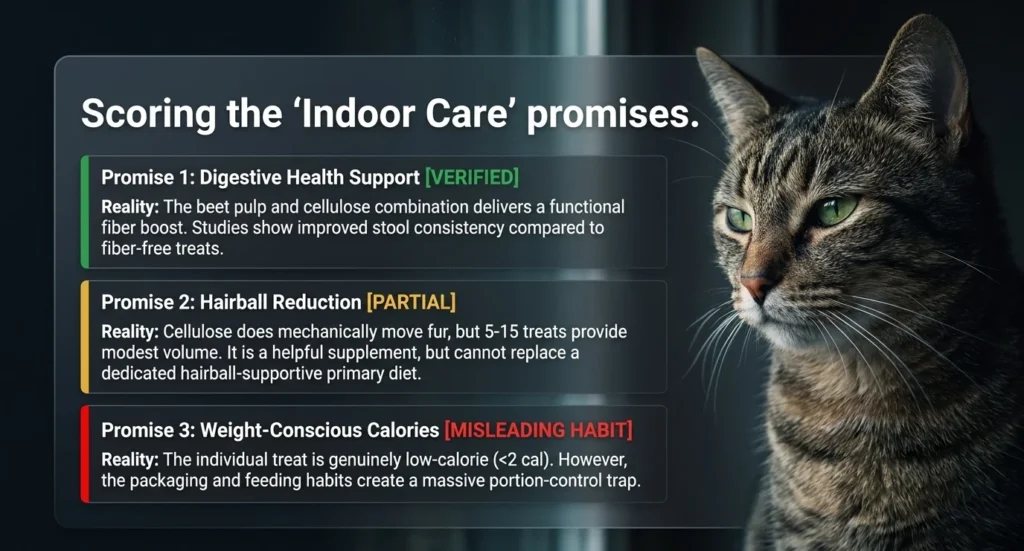
Temptations Indoor Care is marketed specifically for indoor cats with three implicit promises: digestive health support, hairball reduction, and weight-conscious calorie control.
Let’s evaluate each honestly.
Digestive Health Support: The beet pulp and cellulose combination does provide a functional fiber boost that supports gut motility. This is a real benefit, not just marketing language. Cats fed treats with beet pulp consistently show slightly better stool consistency than those fed fiber-free treats in comparable dietary contexts.
Hairball Reduction: The powdered cellulose does mechanically help move ingested fur through the digestive tract. However, the volume of fiber delivered in 5–15 treats per day is modest. This is a supplement to a hairball-supportive diet, not a replacement for one. If your cat has serious hairball issues, the fiber in these treats alone will not solve it — your primary food needs to address hairball control as well.
Weight-Conscious Calories: At under 2 calories per treat, the per-unit calorie count is genuinely low. The problem is not the individual treat — it is the portion habit that develops around them. Many cat owners who think they’re giving “a few treats” are actually giving 15–20 per session. At 20 treats per day, that’s 40 calories — nearly 20% of a 10 lb indoor cat’s entire daily calorie budget.
The Calorie Math That Actually Matters
This is the conversation most treat reviews skip entirely.
An average 10 lb indoor cat needs approximately 180–220 calories per day depending on activity level and body condition. That is not a lot of margin.
| Treats Per Day | Calories from Treats | % of Daily Budget (200 cal baseline) |
|---|---|---|
| 5 treats | ~10 cal | ~5% ✅ Fine |
| 10 treats | ~20 cal | ~10% ✅ Acceptable |
| 15 treats | ~30 cal | ~15% ⚠️ Reduce main meal |
| 20 treats | ~40 cal | ~20% 🔴 Too high |
| 30 treats | ~60 cal | ~30% 🔴 Significantly over |
The practical rule: Cap Temptations Indoor Care at 10 treats per day maximum for an average-sized indoor cat. If you give 10 treats, reduce the main meal portion slightly to offset those 20 calories.
The recommended serving size on the packaging is 15 treats per day. I’d push back on that for a typical 10 lb indoor cat on a calorie-controlled diet — 10 is a more responsible ceiling unless your cat is larger or more active than average.
Palatability — The One Area Where These Are Unmatched
I have to be completely honest here: Temptations Indoor Care Chicken is one of the highest-palatability treats on the entire market.
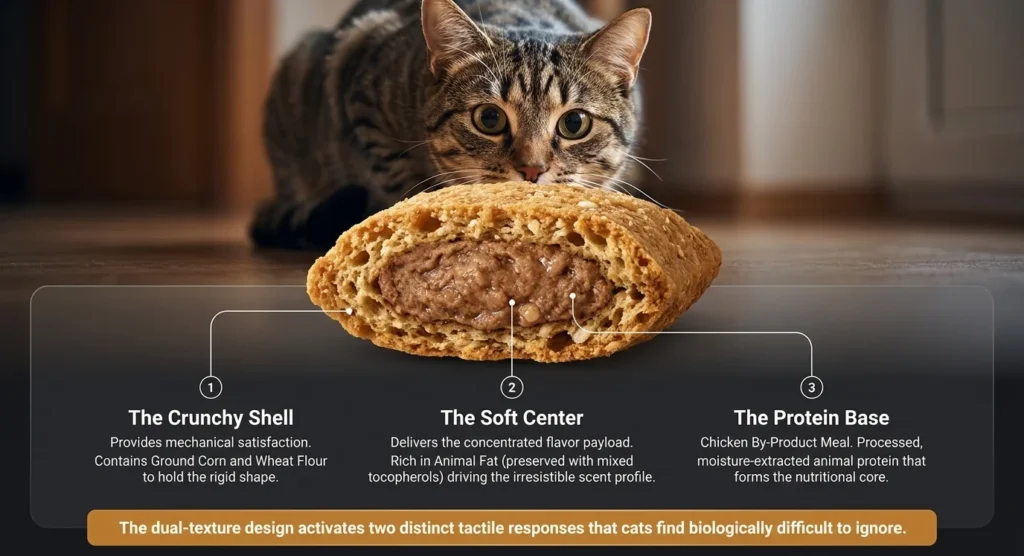
The dual-texture design — crunchy outside, soft center — activates two different tactile responses that cats find difficult to ignore. Add the chicken by-product meal’s concentrated scent profile and the animal fat for richness, and you have a treat formulated with the specific goal of being as appealing as possible to feline senses.
Purreats readers report cats that normally ignore treats will reliably come running at the sound of this bag. Multiple readers have used Temptations Indoor Care as their primary training treat because the motivation level is so high and consistent.
From a reader review on Chewy: “My cat comes running the second I touch the bag. I can’t tell if the hairball control is working but she has not had one in two months.”
Is the strong palatability partly engineered through flavor additives? Almost certainly. But for training, medication delivery, food-to-bowl redirection, and bonding moments, high palatability has real practical value.
When Temptations Indoor Care Makes Sense — and When It Doesn’t
Good use cases:
- Training rewards — the motivation level is extremely high
- Hiding medication — the strong smell and flavor masks pills effectively
- Occasional bonding treats — 5–10 per day, accounted for in the daily calorie total
- Supplementing hairball support on top of a hairball-supportive primary diet
Not the right tool for:
- Daily free-access treat dispensing (too easy to overfeed)
- Replacing hairball-focused primary food — treats alone are not enough
- Cats with grain sensitivities or corn intolerances
- Cats on calorie-restricted weight-loss programs where every calorie is tightly managed
Better Alternatives Worth Knowing
If you want a cleaner ingredient profile while keeping similar palatability and calorie control, these are worth trying:
PureBites Freeze-Dried Chicken (~1 cal/treat) — single ingredient: 100% chicken breast. No grains, no by-products, no fillers. The calorie count is even lower. The palatability is high because it is pure meat smell. Trade-off: no hairball fiber, so you’d need that addressed in the primary food.
Greenies Feline Treats (~1.25 cal/treat) — designed for dental health with added fiber for hairball support. Real chicken leads the ingredient list. More expensive per ounce but a cleaner formula.
Churu Lickable Treats (~7 cal/tube) — pure wet chicken with no grains. Higher calories per serving but exceptional palatability and meaningful hydration benefit. Ideal for cats that refuse wet food and need encouragement to eat moisture-rich options.
Key Takeaways
- Whiskas Temptations Indoor Care Chicken treats are safe for daily use at 10 or fewer per day for a typical 10 lb indoor cat
- First ingredient is chicken by-product meal — a real animal protein, not premium, but acceptable for a treat
- The dual fiber system (cellulose + beet pulp) provides functional hairball support — better than cellulose-only treats
- No artificial dyes — a genuine positive compared to some competing budget products
- The calorie math matters: 15 treats = ~30 calories, roughly 15% of an average indoor cat’s daily budget
- Cap at 10 treats/day and adjust the main meal portion to account for those calories
- For a cleaner grain-free alternative: try PureBites Freeze-Dried Chicken or Churu Lickable Treats
Do you use Temptations as training treats or daily rewards? Drop your routine in the comments — I’ll let you know if the portion size fits your cat’s calorie budget.
Related on Purreats: Best Dry Cat Food for Indoor Cats · Best Cat Food for Indoor Cats · Purina Indoor Cat Food · How to Read a Cat Food Label
Affiliate Disclosure: We may earn a commission from qualifying purchases. All reviews are independent — no brand pays for placement.