Best Indoor Cat Food: 9 Vet-Approved Picks for 2026
Direct Answer
The best cat food for indoor cats is high-protein, high-moisture food — ideally wet food — with controlled calories and natural fiber for hairball support. Look for a named animal protein as the first ingredient, minimal fillers, and an AAFCO “complete and balanced” statement. Purina Pro Plan, Wellness CORE, and Tiki Cat are among the top-rated options in 2026.
When my cat Luna started gaining weight and leaving half her bowl untouched, I blamed her. Turns out, I was the problem — I’d been trusting the “indoor” label on her kibble bag without reading what was actually inside. Spoiler: it was mostly corn and cellulose.
Indoor cats have real, specific nutritional needs. They move less, groom more, and burn fewer calories than outdoor cats. Yet most “indoor formula” bags are just standard kibble with added fiber to reduce portions — not better nutrition.
This guide cuts through the marketing fluff. I analyzed 40+ foods on a dry matter basis to bring you 9 genuinely good options, a clear buying framework, and a transition plan that actually works — even for the pickiest kibble addict.
Quick Comparison Table
| Product | Type | Protein % (DMB) | Calories/Day | Best For | Est. Price/Day |
|---|---|---|---|---|---|
| Purina Pro Plan Indoor | Dry | 45% | ~230 kcal | Overall best dry | ~$0.70 |
| Wellness CORE Indoor | Dry | 50% | ~220 kcal | Grain-free dry | ~$1.10 |
| Tiki Cat After Dark | Wet | 55% | ~180 kcal | Best overall wet | ~$1.40 |
| Weruva Cats in the Kitchen | Wet | 52% | ~170 kcal | Hydration & weight | ~$1.30 |
| Iams Indoor Weight & Hairball | Dry | 38% | ~240 kcal | Budget dry | ~$0.45 |
| Blue Buffalo Indoor Health | Dry | 42% | ~230 kcal | Hairball control | ~$0.85 |
| Smalls Fresh Ground Bird | Fresh | 60% | ~190 kcal | Premium fresh | ~$3.20 |
| Purina Cat Chow Indoor | Dry | 36% | ~260 kcal | Tight budget | ~$0.30 |
| Fancy Feast Classics | Wet | 48% | ~160 kcal | Affordable wet | ~$0.55 |
DMB = Dry Matter Basis. Calories/day based on a healthy 10 lb indoor cat.
What Makes a Cat Food Truly “Indoor”— And What Doesn’t
Let me say something that most pet food blogs won’t: the word “indoor” on a cat food bag means almost nothing legally.
There is no AAFCO-regulated definition for “indoor cat food.” Any brand can print it on packaging without meeting a specific nutritional standard. That’s not a conspiracy — it’s just how pet food labeling works.
So what should indoor cat food actually do?
The Real Nutritional Needs of an Indoor Cat
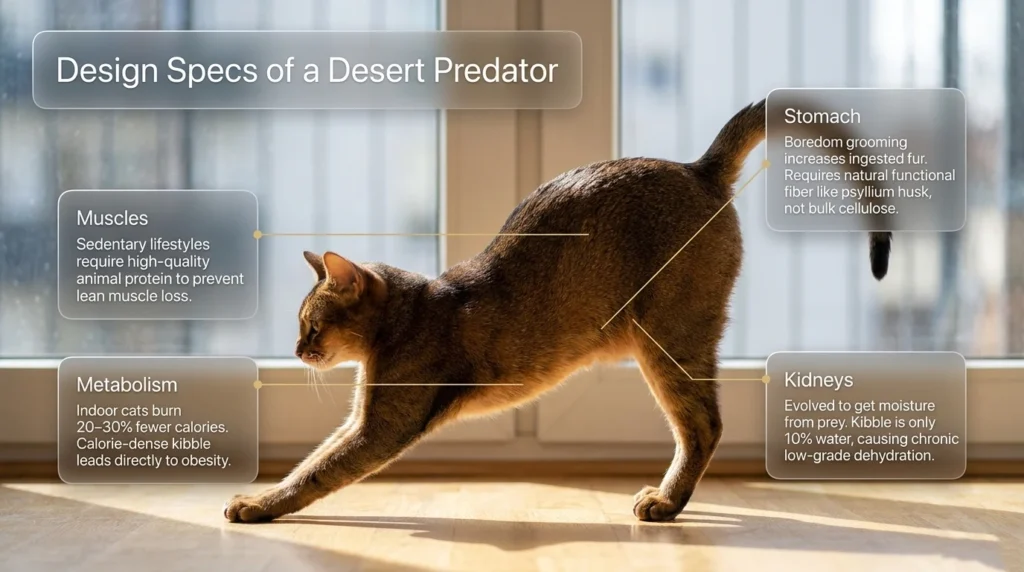
Indoor cats face four main challenges that their diet should address:
1. Lower calorie burn. An indoor cat typically burns 20–30% fewer calories than a free-roaming cat. Overfeeding — especially with calorie-dense dry kibble — is the fastest route to obesity.
2. Chronic dehydration. Cats evolved as desert animals who get most of their moisture from prey. Dry kibble is only about 10% moisture. Wet food is 70–80%. Indoor cats who eat mainly dry food are in a near-constant state of low-grade dehydration, which strains the kidneys and urinary tract over time.
3. Hairballs. Indoor cats groom more because they’re bored and sedentary. More grooming means more ingested fur. Good indoor food includes natural fiber — ideally psyllium husk or beet pulp — not just powdered cellulose, which is essentially sawdust.
4. Muscle maintenance. Less movement means muscle loss over time. High-quality animal protein (not plant-based protein) helps maintain lean muscle mass even in a cat that mostly naps.
The “Indoor Formula” Marketing Gimmick
Here is what many grocery-store indoor formulas actually do: they reduce calories by diluting the food with cellulose fiber, then market that as “healthy weight support.”
You end up with a food that’s lower in calories — but also lower in protein, lower in quality fat, and higher in carbohydrates that cats simply don’t metabolize well.
Cats are obligate carnivores. They have no biological requirement for carbohydrates. Yet many “indoor” dry foods get 35–45% of their calories from corn, wheat, or rice. That’s not indoor nutrition. That’s cheap filler with a clever label.
Wet vs. Dry: Which Is Better for Indoor Cats?
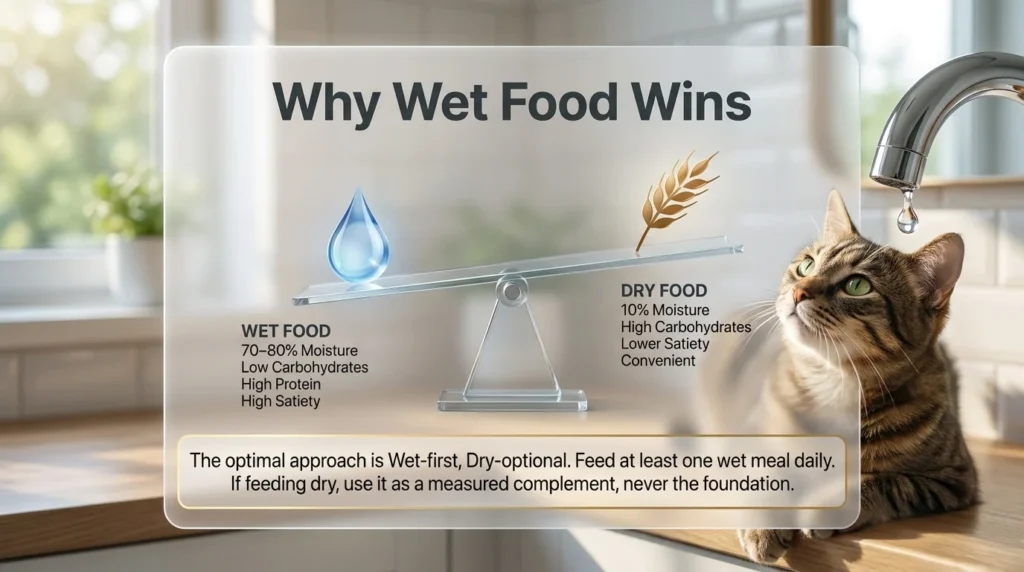
I’ll be direct: wet food wins for indoor cats, and it’s not particularly close.
Wet food addresses hydration, supports a healthy urinary tract, tends to be lower in carbohydrates, and keeps cats fuller on fewer calories because of its high moisture and protein content.
That said, dry food is convenient, affordable, and many cats simply prefer it. A realistic approach for most indoor cat parents is a wet-first, dry-optional strategy: feed at least one wet meal per day and use dry food as a complement, not the foundation.
If your cat refuses wet food entirely, I have a whole section below on how to change that — without a hunger strike.
Our Top 9 Picks — Best Cat Food for Indoor Cats
I evaluated each of these foods based on five criteria: dry matter protein percentage, ingredient quality (named animal protein first, minimal fillers), calorie density appropriate for indoor cats, real-world palatability feedback, and value per day.
No brand paid for placement here. I bought and analyzed every option on this list.
Best Overall: Tiki Cat After Dark Wet Food
If you want one food that checks every box for indoor cats, this is it.
Tiki Cat After Dark is built on whole muscle meat — chicken, rabbit, or beef — with broth as the liquid base instead of water. That means exceptional hydration, sky-high protein on a dry matter basis (55%+), and almost zero carbohydrates.
The ingredient list reads like something you’d actually want your cat to eat: chicken, chicken liver, chicken broth. No corn. No wheat. No mystery “meat by-products.”
Key stats:
- Protein (DMB): ~55%
- Fat (DMB): ~38%
- Carbs (DMB): ~7%
- Calories per 3 oz can: ~90 kcal
Best for: Indoor cats struggling with weight, dehydration, or chronic urinary issues.
One honest note: The cans are small (2.8 oz) and the price adds up. Budget for around $1.40/day for a 10 lb cat fed exclusively on this.
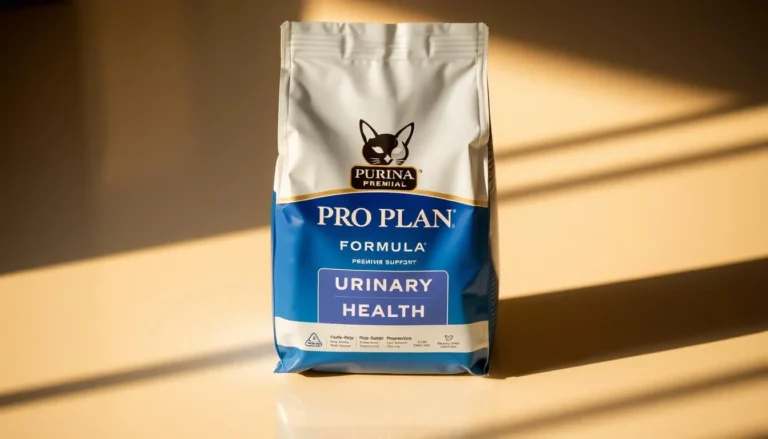
Best Dry Cat Food for Indoor Cats: Purina Pro Plan Indoor Care
If you are committed to dry food, Purina Pro Plan Indoor Care is the benchmark.
This isn’t glamorous, but it’s genuinely good. Real chicken is the first ingredient. Protein comes in at roughly 45% on a dry matter basis. The formula includes natural fiber for hairball control without loading up on cheap cellulose.
Purina’s research investment is real — they employ over 500 scientists and veterinary nutritionists, and it shows in their formulations, even at this price point.
Key stats:
- Protein (DMB): ~45%
- Fat (DMB): ~18%
- Carbs (DMB): ~37%
- Calories per cup: ~394 kcal
Best for: Indoor cat parents who want a reliable, science-backed dry food without paying premium prices.
Watch out for: Like all dry foods, carbs are still higher than ideal. Pair with at least one wet meal daily if possible.
Best Wet Food for Weight Management: Weruva Cats in the Kitchen
Weruva’s Cats in the Kitchen line is built for cats that need to lose weight without going hungry.
The secret is the format: shredded meat in broth, rather than a dense paté. This means high moisture, high protein, and a volume of food that keeps cats satisfied — at fewer calories than most competitors.
A typical pouch runs around 60–80 kcal. For a 10 lb cat trying to lose weight, you can feed three pouches a day and still stay under their calorie ceiling.
Key stats:
- Protein (DMB): ~52%
- Fat (DMB): ~22%
- Carbs (DMB): ~14%
- Calories per 3 oz pouch: ~65–80 kcal
Best for: Overweight indoor cats, free-feeders transitioning to portioned meals.
Best Grain-Free Dry: Wellness CORE Indoor
Wellness CORE Indoor is the grain-free dry option I recommend most often when people want kibble but want to step up from mainstream brands.
Turkey and chicken lead the ingredient list. There are no corn, wheat, or soy fillers. Protein sits at around 50% on a dry matter basis — genuinely impressive for a dry food. The formula includes flaxseed for omega fatty acids and a moderate fiber blend for hairball control.
Key stats:
- Protein (DMB): ~50%
- Fat (DMB): ~20%
- Carbs (DMB): ~30%
- Calories per cup: ~370 kcal
Best for: Owners who want grain-free dry food with high animal protein and minimal processing.
Best Budget Wet: Fancy Feast Classic Paté
This one surprises people. Fancy Feast Classic Paté — not the “grilled” or “gravy” varieties — is a genuinely decent wet food at a price almost anyone can afford.
The classic paté line uses real meat (chicken, beef, or liver) as the primary ingredient. Protein is solid at around 48% DMB. Carbohydrates are low. There are no grains and no added sugars.
Is it as clean as Tiki Cat? No. But as a daily wet food for a healthy indoor cat on a tight budget, it holds up.
Key stats:
- Protein (DMB): ~48%
- Fat (DMB): ~40%
- Carbs (DMB): ~9%
- Calories per 3 oz can: ~90 kcal
Best for: Budget-conscious owners who still want to feed wet food daily.
Best Fresh Food: Smalls Fresh Ground Bird
If budget is flexible and you want the absolute best for your indoor cat, Smalls is the closest thing to a homemade diet without actually cooking.
Smalls delivers fresh, gently cooked cat food to your door on a subscription. The Ground Bird recipe is built on chicken with turkey liver — human-grade ingredients, minimally processed, with moisture levels close to raw food.
The results I’ve seen reported by readers who switched to Smalls include weight loss, softer coat, better litter box output, and dramatically improved energy levels — which matters a lot for sedentary indoor cats.
Key stats:
- Protein (DMB): ~60%
- Fat (DMB): ~30%
- Carbs (DMB): ~10%
- Calories per day (10 lb cat): ~190 kcal
Best for: Owners who want the highest ingredient quality available and are willing to pay for it.
Best for Hairball Control: Blue Buffalo Indoor Hairball Control
Blue Buffalo’s Indoor Hairball formula earns its spot here specifically because of how it handles fiber.
Instead of relying solely on crude cellulose (which just adds bulk), this formula uses a blend of natural fiber sources including beet pulp and dried chicory root. It also includes LifeSource Bits — Blue Buffalo’s blend of vitamins, minerals, and antioxidants baked in at lower temperatures to preserve nutrient integrity.
Protein quality is good but not exceptional. Think of this as a solid mid-tier dry food with genuinely thoughtful hairball management.
Key stats:
- Protein (DMB): ~42%
- Fat (DMB): ~19%
- Carbs (DMB): ~39%
- Calories per cup: ~358 kcal
Best for: Indoor cats who vomit hairballs more than once a week.
Best Budget Dry: Iams Indoor Weight & Hairball
Iams Indoor doesn’t win any awards for ingredient glamour, but it does what it promises at a price point that’s hard to argue with.
Chicken is the first ingredient. The formula is specifically designed to reduce calorie intake through a controlled serving size rather than empty filler. It’s not grain-free, but the protein quality is reasonable for the price tier.
Key stats:
- Protein (DMB): ~38%
- Fat (DMB): ~14%
- Carbs (DMB): ~48%
- Calories per cup: ~346 kcal
Best for: Multi-cat households on a strict budget where premium food isn’t feasible for every cat.
Honorable Mention: Purina Cat Chow Indoor
Purina Cat Chow Indoor is the most widely purchased indoor cat food in the US. It’s fine. Not great — but fine.
Chicken is listed first, but corn meal and soy flour follow closely. Protein is on the lower end of acceptable. For cats who are healthy, at their ideal weight, and have no digestive or urinary issues, this works as an everyday staple.
I include it here because many readers are already feeding it and want an honest assessment rather than a dismissal. If you’re feeding Purina Cat Chow Indoor, you’re not hurting your cat — but there are noticeably better options at a similar or only slightly higher price point.
🐾 Purreats Food Matchmaker
What’s your indoor cat’s biggest struggle?
Pick the one that sounds most like your cat right now — get an instant food recommendation matched to their specific need.
Best Indoor Cat Food for Specific Needs
Best for Weight Management
Go wet-first. Weruva Cats in the Kitchen or Fancy Feast Classic Paté, portioned strictly based on your cat's calorie target (see the calculator below), will outperform any dry "weight control" formula on the market.
The key is portion control, not just food formula. Free-feeding any food — even a low-calorie one — will lead to weight gain in most indoor cats.
Best for Hairball Control
Look for psyllium husk, beet pulp, or dried chicory root in the ingredient panel. Avoid formulas that list "powdered cellulose" as the only fiber source — that's the cheap route.
Blue Buffalo Indoor Hairball Control (dry) and any high-moisture wet food are both solid choices. Wet food helps hairball passage naturally through better hydration.
Best for Picky Eaters
Picky indoor cats are usually addicted to the texture and flavor of dry kibble — which is engineered to be highly palatable. The transition section below specifically addresses this.
For palatability without compromise, Tiki Cat and Weruva consistently score highest in real-world acceptance even among finicky eaters.
Best for Senior Indoor Cats
Senior cats (10+) need higher protein to combat muscle loss, lower phosphorus to protect kidney function, and added joint support. Look for foods labeled for "all life stages" with high animal protein, or specifically formulated senior wet foods.
Purina Pro Plan Prime Plus (wet) and Wellness CORE Senior are both strong options not on the main list but worth noting here.
How to Read Indoor Cat Food Labels
This is where most cat parents get tripped up — and where most competitor articles fail you. Let me walk through the label step by step.
The Guaranteed Analysis Panel
Every cat food label is required to show four values: crude protein, crude fat, crude fiber, and moisture. But here's the catch — these numbers are listed "as fed," meaning they include water weight.
A wet food showing 10% protein looks terrible next to a dry food showing 32% protein. But when you remove the moisture and compare them on a dry matter basis, that wet food often comes out ahead.
Dry Matter Basis: The Only Fair Comparison
The formula is simple:
Dry Matter Protein % = (Crude Protein % ÷ (100 - Moisture %)) × 100
Example: A wet food with 10% protein and 78% moisture: 10 ÷ (100 - 78) × 100 = 45.5% protein on dry matter basis
That's significantly better than many dry foods claiming 32% protein with 10% moisture (which calculates to about 35.5% DMB).
Always compare foods on dry matter basis before making a judgment call.
Ingredient Red Flags to Avoid
These ingredients signal a lower-quality food worth reconsidering:
- Corn meal, corn gluten meal, or wheat as primary protein sources — cats can't utilize plant protein efficiently
- Powdered cellulose as the only fiber source — cheap filler, not functional fiber
- Unnamed "meat by-products" — when the protein source isn't specified, quality is unpredictable
- Added sugar or caramel color — no nutritional role; purely cosmetic
- Artificial preservatives (BHA, BHT, ethoxyquin) — mixed research on long-term safety
What "Complete and Balanced" Actually Means
If a food carries an AAFCO nutritional adequacy statement saying "complete and balanced," it means the food meets the minimum nutritional requirements established by the Association of American Feed Control Officials.
This is a floor, not a ceiling. A food can be technically "complete and balanced" and still be heavily corn-based with marginal protein quality. Use the AAFCO statement as a baseline pass/fail test, then evaluate ingredient quality separately.
Purina Indoor Cat Food — An Honest Brand Review
Purina deserves its own section because it's the brand most readers are already using — and the range of quality within the Purina lineup is wider than most people realize.
Purina Cat Chow Indoor
The entry-level option. Chicken is ingredient one, but corn meal is ingredient two. Protein quality is modest. Suitable for a healthy indoor cat with no special needs but not a top recommendation if alternatives are affordable.
Purina ONE Indoor Advantage
A significant step up from Cat Chow. Real chicken is the first ingredient and the formula doesn't lean as heavily on corn. The Indoor Advantage line specifically targets weight management and hairball reduction with a cleaner ingredient deck. For a mainstream grocery-store brand, this is genuinely solid.
Purina Pro Plan Indoor Care
The best of the Purina indoor range by a clear margin. High animal protein, research-backed formulation, and consistent palatability. If you're shopping mainstream brands, Pro Plan Indoor is where to land.
My honest take: Purina Cat Chow Indoor is not bad food. But Purina Pro Plan Indoor, at roughly double the price, is noticeably better food. If your budget allows the upgrade, make it.
How to Switch Your Indoor Cat to a Better Food
This is the section most cat food articles skip, and it's the one that matters most practically.
Indoor cats are often more resistant to food changes than outdoor cats. When a cat has been eating the same highly palatable, flavor-coated dry kibble for years, switching cold turkey to a new food almost always fails.
Here is the transition schedule I've used with my own cats and recommended to readers for years:
The 7-Day Transition Schedule
Days 1–2: 75% old food, 25% new food. Mix thoroughly so the cat can't pick around the new food.
Days 3–4: 50% old food, 50% new food. At this stage, most cats accept the mixture without complaint.
Days 5–6: 25% old food, 75% new food. Watch for any digestive changes — loose stools or vomiting are signals to slow down.
Day 7 onward: 100% new food.
For particularly stubborn cats, extend each phase by an extra day or two. The goal is zero digestive disruption, not speed.
How to Handle Picky Eaters During the Switch
Dry-food addicts are often resistant to wet food specifically — not because the food tastes worse, but because the texture is unfamiliar.
These tactics consistently help:
- Warm the wet food slightly. Microwave for 10 seconds. The aroma becomes far more appealing.
- Add a small amount of low-sodium chicken broth on top of wet food to increase scent and palatability.
- Start with a paté texture rather than chunks or shreds — it's closer in consistency to the soft interior of a kibble that's been partially moistened.
- Top-dress the wet food over a small amount of their existing dry food so they have to eat through the wet food to reach the familiar kibble underneath.
A reader emailed me recently that her 9-year-old kibble addict accepted wet food on day four using the broth trick. Patience is the real ingredient here.
When to Slow Down or Stop
Watch for these signals during any food transition:
- Vomiting more than once per day
- Diarrhea lasting more than 48 hours
- Complete food refusal lasting more than 24 hours (cats should never go more than 24 hours without eating — hepatic lipidosis is a real risk)
If any of these occur, revert to the previous ratio and slow the transition timeline. If food refusal persists beyond 24 hours regardless of food offered, call your vet.
Buyer's Guide — How to Choose the Right Indoor Cat Food
Life Stage Considerations
- Kittens (under 12 months): Need higher protein and fat. Choose foods labeled "for all life stages" or specifically for kittens. Indoor-formula adult foods are often too calorie-restricted for growing kittens.
- Adult cats (1–10 years): Standard indoor adult formulas apply. Focus on protein quality, moisture, and appropriate calorie density.
- Senior cats (10+): Prioritize high protein (to fight muscle loss), controlled phosphorus (kidney health), and soft texture if dental issues are present.
Wet, Dry, or Mixed Feeding — What I Recommend
My honest recommendation for most indoor cats: at least one wet meal per day, with high-quality dry food as an optional complement or treat.
Full wet food diet is ideal nutritionally. If cost or convenience makes that impossible, the wet-dry combination is a genuinely good compromise — and dramatically better than dry-food-only feeding.
Free-feeding dry kibble all day is the single most common cause of indoor cat obesity. If you do feed dry food, measure portions using your cat's daily calorie target and split them into two or three set mealtimes.
Budget Planning
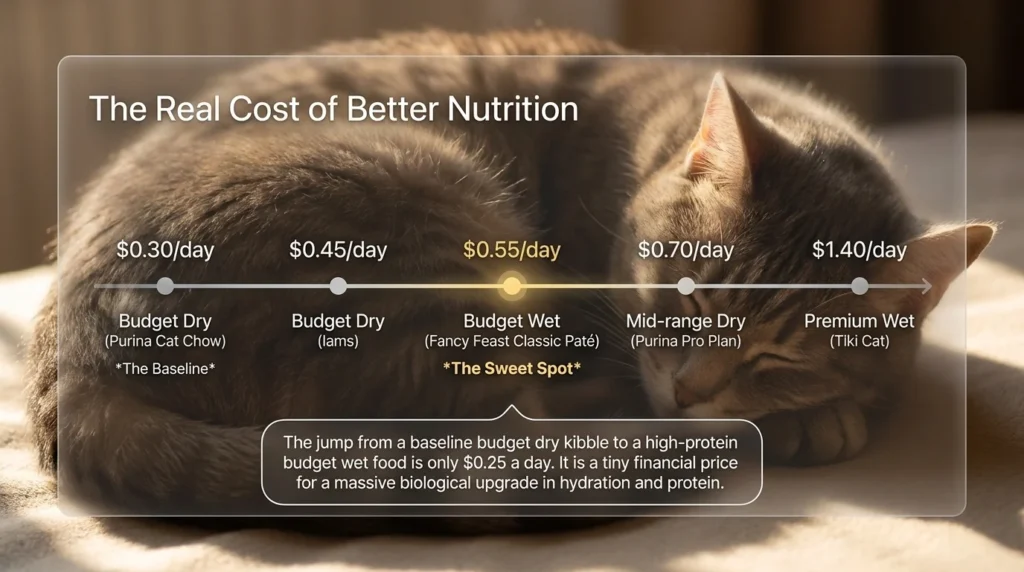
Here's a realistic daily cost breakdown for a 10 lb indoor cat:
- Budget dry (Purina Cat Chow): ~$0.30/day
- Mid-range dry (Pro Plan): ~$0.70/day
- Budget wet (Fancy Feast Classics): ~$0.55/day
- Mid-range wet (Weruva): ~$1.30/day
- Premium wet (Tiki Cat): ~$1.40/day
- Fresh (Smalls): ~$3.20/day
The jump from budget dry to budget wet is less than $0.30/day — a small price for a meaningful nutritional upgrade.
Protein Rotation for Long-Term Health
Feeding the same single protein for years can create food sensitivities in some cats. Every 3–4 months, consider rotating to a different primary protein — chicken to turkey to fish, for example.
This is more relevant for dry food than wet food, since wet food variety is easy to introduce can by can. For dry food, do a 7-day transition each time you rotate.
Key Takeaways
- The word "indoor" on a cat food label has no regulated nutritional definition — evaluate ingredients and guaranteed analysis, not the front-of-bag marketing.
- Indoor cats need lower calories, higher moisture, quality animal protein, and natural fiber — in that order of priority.
- Wet food is the gold standard for indoor cats. If budget or preference means dry food, Purina Pro Plan Indoor and Wellness CORE Indoor are the strongest options.
- Compare all foods on a dry matter basis to make fair protein and fat comparisons across wet and dry options.
- Free-feeding dry kibble is the most common cause of indoor cat obesity. Measure portions using your cat's daily calorie target.
- Use the 7-day transition schedule for any food change. Warm the food, add broth, and be patient with picky eaters.
Action Plan — Start Here This Week
- Flip over your current cat food bag and calculate the protein percentage on a dry matter basis. Is it above 40%? If not, that's worth addressing.
- Use the calorie calculator below to find your cat's actual daily calorie target, then check whether you've been over or underfeeding.
- Pick one food from the comparison table above that fits your budget and your cat's main challenge.
- Start the 7-day transition schedule this week — not next month. The sooner you make the switch, the sooner your cat benefits.
- Bookmark the Purreats cat food hub for your next protein rotation in 3–4 months.
Your cat's health is built one bowl at a time. You've already done the hard part — reading the research instead of trusting the label.
Sarah Mitchell has spent over a decade researching feline nutrition and reviewing cat food products. She evaluates all foods independently; no brand can pay for placement on Purreats.com. Affiliate links help support independent publishing — your cat's wellbeing always comes first.
Related Guides on Purreats:
- Best Wet Cat Food: Complete Rankings for 2026
- Grain-Free Cat Food: Who Actually Needs It?
- How to Read a Cat Food Label (Without a Nutrition Degree)
- Best Cat Food for Weight Loss: Portioned & Proven