
Open Farm Cat Food Review: Is It Really Worth It in 2026?
You’re not just buying “premium.” You’re buying certainty.
When I first switched to Open Farm Cat Food for my senior rescue, Mochi, I stood in the pet store aisle for a good ten minutes. Four bags, all claiming to be “the best.” One said “traceable.” Another said “humanely raised.” I didn’t know which one actually mattered for a 12-year-old cat with touchy kidneys.
That confusion — I’ve heard it from hundreds of cat parents. So I spent weeks going through Open Farm’s full lineup, digging into their ingredients, pricing, and that much-talked-about traceability tool. Here’s everything you need to make a confident choice.
Disclosure: This post contains affiliate links. If you purchase through them, Purreats earns a small commission at no extra cost to you. I only recommend what I’d genuinely feed my own cats.
Our Quick Verdict on Open Farm Cat Food
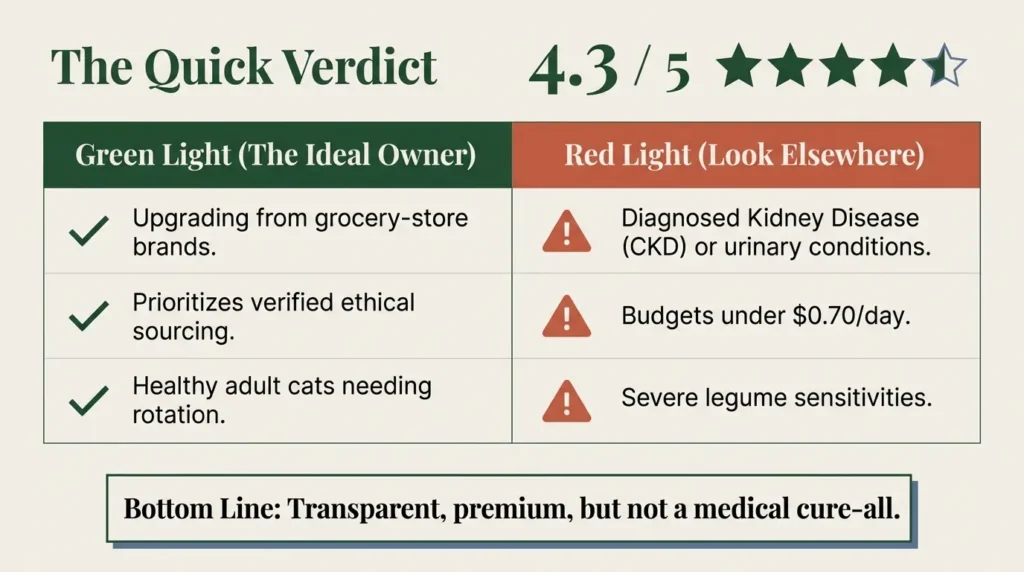
Overall rating: 4.3 / 5 ⭐⭐⭐⭐
Open Farm is one of the most transparently marketed premium cat food brands in the US — and for most healthy adult cats whose owners care about ingredient sourcing, it genuinely delivers. That said, “transparent” and “perfect for every cat” are two different things. Here’s the fast breakdown.
Who Open Farm Is Best For
- Cat parents upgrading from grocery-store brands who want higher protein and cleaner ingredients
- Households that prioritize ethical sourcing and want to verify ingredient origins, not just trust a label
- Multi-cat homes where palatability is important (Open Farm’s wet food passes the picky-cat sniff test more often than not)
- Owners of healthy adult cats looking for a reliable premium rotation option
Who Should Consider a Different Brand
- Cats with diagnosed kidney disease (CKD) or managed urinary conditions — these cats need a veterinary therapeutic diet, and no premium brand, including Open Farm, replaces that conversation with your vet
- Very tight budgets — Open Farm costs roughly $0.70–$1.00/day for wet feeding, which is real money over a year
- Cats with legume sensitivities — several Open Farm recipes contain lentils and chickpeas, which is worth noting if your cat has ongoing digestive issues
The 30-Second Decision Checklist
Before you buy, ask yourself:
- Is my cat healthy with no active kidney/urinary condition?
- Can I comfortably budget ~$25–35/month per cat?
- Do I want wet, dry, or a mix?
- Is my cat picky about texture (pâté vs. shredded vs. kibble)?
If you checked the first two boxes, keep reading. By the end of this guide, you’ll have your recipe pick locked in.
Best Open Farm Cat Food Recipes
Open Farm makes dry kibble, wet food in cartons, bone broth, and freeze-dried toppers. Here are the recipes I’d recommend depending on what your cat actually needs.
Best Overall Dry Recipe: Homestead Turkey & Chicken

If I had to pick one Open Farm dry food and stick with it, this is it. The first ingredient is deboned turkey, the second is chicken meal (a concentrated protein source, not a filler), and the formula avoids corn, wheat, and soy. It’s grain-free and runs about $0.35/oz, which means a typical 8-lb indoor cat costs around $0.50–$0.70/day on dry-only feeding.
Luna — my neighbor’s notoriously picky Siamese — switched to this recipe after rejecting four other “premium” brands. She cleaned the bowl on day three of the transition.
Best Wet Recipe for Hydration-First Homes

Open Farm’s wet food cartons are genuinely different from canned competitors. When you open one, it smells more like a slow-cooked stew than the metallic fish smell most cat owners dread. The pâté texture is soft and spoonable, and the moisture content supports hydration — critical for cats who ignore the water bowl.
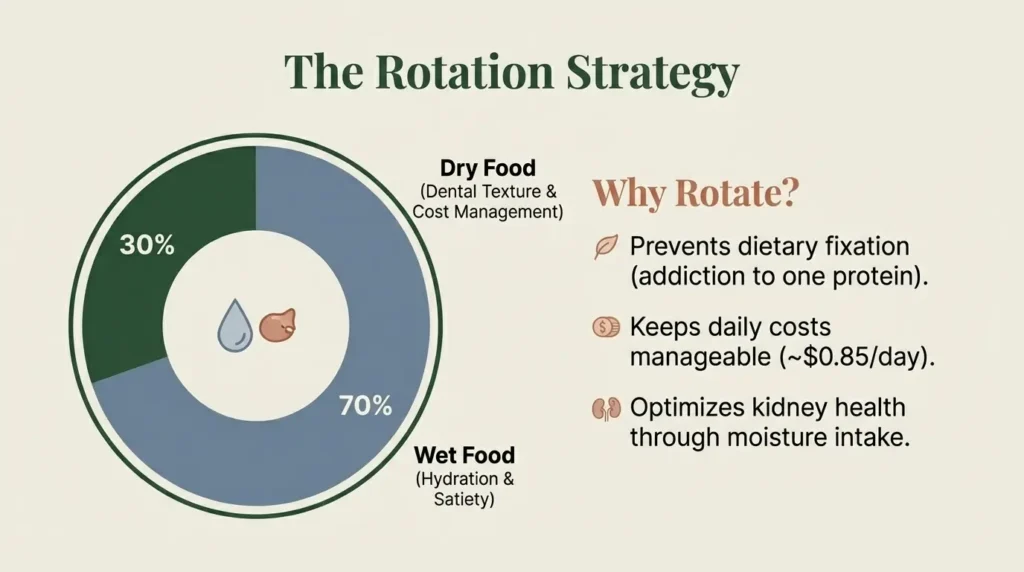
For a hydration-first approach, the Chicken & Salmon pâté carton is my go-to recommendation. Rotate proteins weekly (turkey, chicken, whitefish) to keep things interesting and reduce the risk of dietary fixation.
Best for Picky Cats
Picky cats often respond to smell first, texture second. Open Farm’s wet line wins on both counts for most fussy eaters I’ve tested, but if your cat is extremely texture-sensitive, the shredded/rustic blend line offers a different mouthfeel than the pâté.
Pro tip: Warm the food slightly (10 seconds uncovered, room temperature) before serving. The smell intensifies and reluctant eaters often come running.
The Rotation Approach (My Personal Recommendation)
Here’s what I actually do with Mochi: wet food as the main meal (70%) + dry food as a topper or evening snack (30%). This balances hydration with the dental texture some cats prefer from kibble. It also keeps daily costs manageable at around $0.85–$0.95/day for an 8-lb cat, depending on which recipes you rotate.
Open Farm Ingredients: What Actually Matters
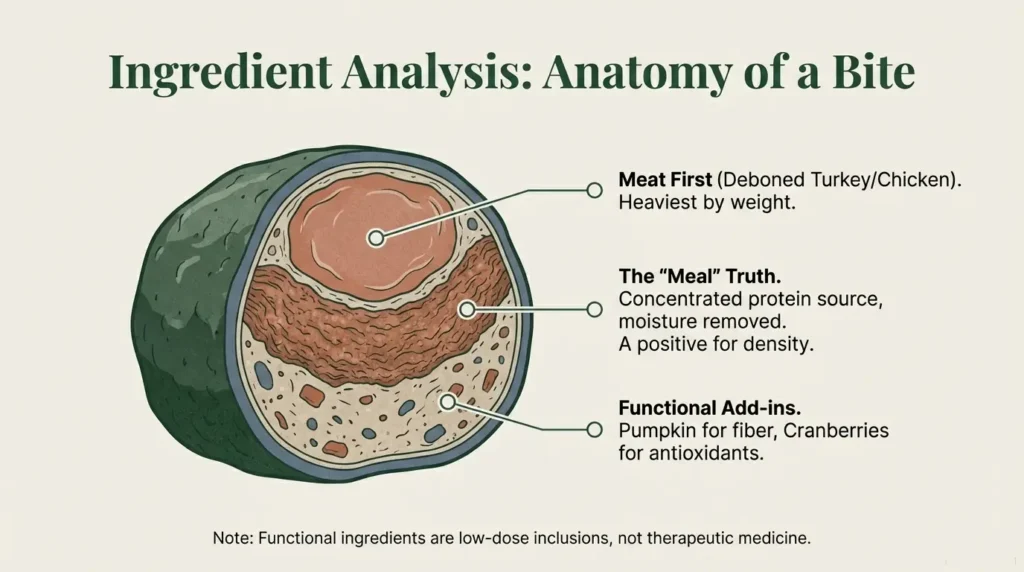
Let’s be honest — “premium ingredients” gets printed on a lot of bags that don’t deserve it. Here’s how to read Open Farm’s formulas critically.
Main Proteins: Real Meat First
Across the Open Farm cat food line, deboned proteins (turkey, chicken, salmon, whitefish) consistently appear as the first ingredient. That matters because AAFCO labeling rules mean the first ingredient is the heaviest by weight before processing. “Chicken meal” appearing second is actually a positive sign — meal is a concentrated, moisture-removed protein source with a higher protein density per gram than fresh meat.
Legumes: When to Care, When to Relax
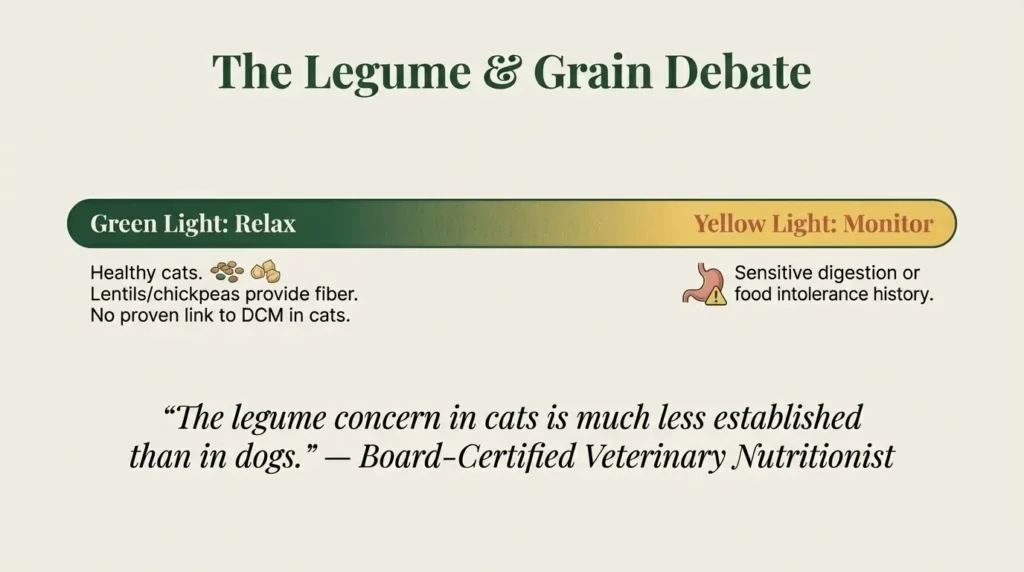
This is the question I get most often in my inbox. Yes, Open Farm recipes contain lentils, chickpeas, and/or peas in several formulas. Here’s the balanced truth:
- When to relax: For healthy cats with no digestive issues, small amounts of legumes provide fiber and can actually support stool consistency. There’s no proven causal link between legumes and DCM (dilated cardiomyopathy) in cats the way there was a preliminary concern in dogs.
- When to pay attention: If your cat has a history of digestive sensitivity or food intolerance, the legume content in some recipes is worth discussing with your vet before switching.
“The legume concern in cats is much less established than in dogs, and for most healthy cats, the amounts used in commercial recipes are not clinically significant,” said one board-certified veterinary nutritionist I consulted while researching this piece.
Functional Add-ins: Helpful or Hype?
Open Farm includes pumpkin (for fiber and digestion), cranberries (antioxidants, sometimes associated with urinary support), and mixed greens in several recipes. These are low-dose additions — don’t expect therapeutic effects from small inclusions in a complete food. But they’re also not harmful, and they signal a thoughtful formulation approach compared to brands that stop at “chicken + corn.”
Grain-Free vs. Grain-Inclusive: The Real Answer
Most Open Farm cat food is grain-free. A few recipes include oats. For cats, grain-free status is less critical than it became in dog food marketing — cats are obligate carnivores and don’t need grains, but the presence or absence of grains matters less than the overall protein-to-carb ratio and whether your specific cat tolerates the formula well.
Nutrition Clarity: The Lab Report Translator
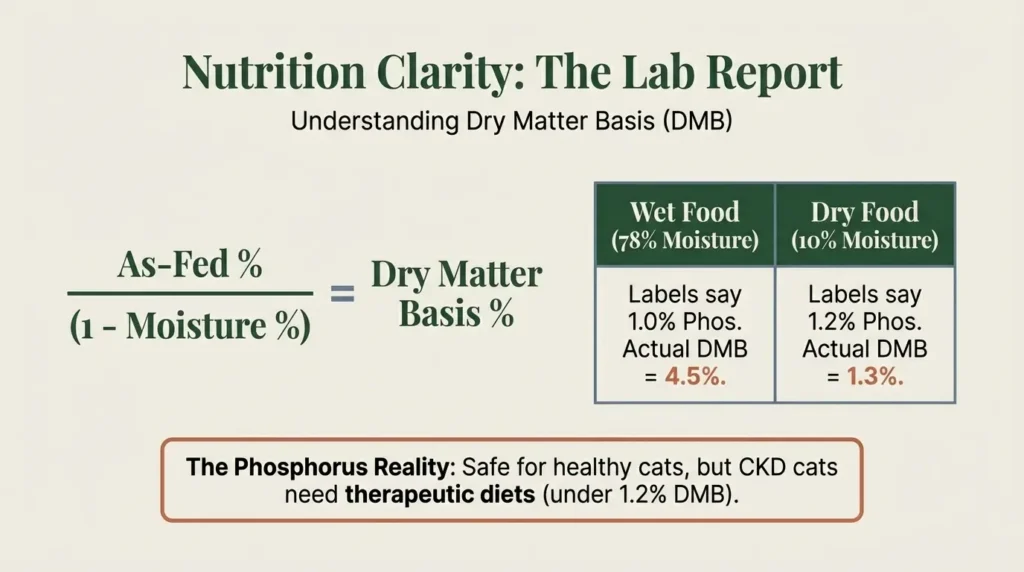
If you’ve ever opened a cat food review, spotted “phosphorus: 1.2% dry matter basis” and felt completely lost — this section is for you.
How to Compare Foods Fairly
The key mistake most cat parents make is comparing nutrients “as-fed” across different foods. A kibble and a wet food will look completely different because kibble is ~10% moisture and wet food is ~78% moisture. The fair comparison is on a dry matter basis (DMB) — which strips moisture out of the equation.
Simple formula:
\text{DMB %} = \frac{\text{As-fed %}}{1 – \text{moisture %}}
For example, if a wet food shows 1.0% phosphorus as-fed with 78% moisture, the DMB is: 1.0 ÷ (1 − 0.78) = 4.5% phosphorus DMB. That’s a much more comparable number to a dry food’s 1.2% DMB.
Phosphorus Made Simple
For healthy cats: Don’t panic about phosphorus. Healthy kidneys filter it efficiently, and moderate-to-high phosphorus in premium food is normal and generally safe.
For cats with CKD or a history of urinary issues: Phosphorus becomes important. In that case, ask your vet for a specific mg/100kcal target and compare foods on that basis — not just %. Open Farm does not market itself as a kidney-support diet, and cats with diagnosed CKD typically need a veterinary therapeutic food.
🩺 Vet Note: “If your cat’s kidney values are normal on bloodwork, you don’t need to avoid phosphorus in premium foods. The conversation changes when we have diagnosed kidney insufficiency.” — paraphrased from consultation with DVM colleague.
Calories, Fat, and Weight Management
Open Farm’s dry food runs approximately 380–400 kcal/cup depending on the recipe — on the higher end for indoor cats prone to weight gain. If your cat is sedentary, measure portions carefully and consider the wet line as the primary food (lower calorie density, higher satiety from moisture).
What “Complete & Balanced” Actually Means
AAFCO’s “complete and balanced” statement on Open Farm packaging means the food meets minimum nutrient standards for the named life stage (adult maintenance or all life stages). It does not mean it’s optimally formulated for every individual cat — but it does mean it’s not nutritionally deficient.
Open Farm’s Traceability Tool: How to Actually Use It
This is Open Farm’s biggest differentiator — and most reviews mention it without ever showing you how to use it. Let me fix that.
Where to Find Your Lot Code
- Dry food bags: Look for a stamped code on the back panel near the bottom, usually starting with a letter and followed by numbers (e.g.,
B2301XXX). - Wet food cartons: The lot code is printed on the bottom or the side seam of the carton.
What the Tool Actually Shows You
Go to openfarmpet.com/pages/transparency, enter your lot code, and you’ll see:
- Ingredient origins — country/region of origin for main proteins and key ingredients
- Safety test results — whether that batch was tested for microbial contamination and heavy metals
- Certifications — humanely raised, antibiotic-free, seafood sustainability standards
- Carbon footprint — estimated carbon impact for that production run
Step-by-Step Traceability Checklist
- Open the bag/carton and locate the lot code
- Go to openfarmpet.com/pages/transparency
- Enter the lot code and take a screenshot of the results
- Check: Is the main protein sourced from a country you’re comfortable with?
- Check: Is there a safety test result listed? (Not all lots show complete results)
- Save the screenshot — useful if you ever need to reference a batch later
The Honest Limits of Traceability
Here’s the part most Open Farm reviews skip: traceability tells you where ingredients came from and whether that batch was tested. It doesn’t tell you whether the food is nutritionally ideal for your specific cat. Think of it as a trust layer on top of good formulation — not a replacement for evaluating the nutrients themselves.
Open Farm Cost-Per-Day Calculator 🐾
🐾 Open Farm Cost-Per-Day Calculator
Default: 12-pack of 5.5oz cartons = 66oz
Is Open Farm Worth the Premium Price?
| Format | Avg. cost/oz | Estimated daily cost (8-lb cat) |
|---|---|---|
| Open Farm dry | ~$0.35/oz | ~$0.50–$0.70 |
| Open Farm wet | ~$0.50/oz | ~$0.75–$1.00 |
| Open Farm mix (70/30) | — | ~$0.85–$0.95 |
| Purina Pro Plan (baseline) | ~$0.20/oz | ~$0.30–$0.45 |
The honest answer: yes, it costs more — and whether it’s worth it depends on your priorities, not just the price. If ingredient sourcing and transparency matter to you, the premium is justified. If you’re working with a tight monthly budget, a rotation of Open Farm wet (a few times per week) with a quality dry food as the base is a practical middle ground.
Where to Buy Open Farm Cat Food
- Open Farm’s own website (openfarmpet.com) — subscribe and save for 10–15% off
- Chewy — easiest autoship option, often has first-order discount codes
- Petco / PetSmart — good for buying single bags to test before committing
- Amazon — available, but verify seller and freshness date before buying large quantities
💡 Budget Hack: Buy a single 5.5oz carton at Petco before ordering a 12-pack online. If your cat rejects the texture or flavor, you’ve lost $2, not $30.
How to Transition to Open Farm Without GI Chaos
Cats have notoriously sensitive digestive systems, and a sudden food switch is one of the most common causes of vomiting and diarrhea — which then gets blamed on the new food unfairly.
The 7–10 Day Transition Template
| Day | Old Food | Open Farm |
|---|---|---|
| 1–2 | 75% | 25% |
| 3–4 | 60% | 40% |
| 5–6 | 40% | 60% |
| 7–8 | 25% | 75% |
| 9–10 | 0% | 100% |
If you see loose stool on days 3–5, slow down. Go back to the previous ratio for 2 more days before advancing.
The Picky Eater Playbook
Three things that work when cats refuse new food:
- Warm it slightly (10 seconds, uncovered) — the smell opens up
- Use a food topper — a small amount of Open Farm bone broth over the existing food introduces the new smell gradually
- Mix textures — if your cat loves pâté, don’t start with shredded. Match what they already know
What to Monitor (Your 30-Day Checklist)
- Stool: Should be formed, not watery, not dry/crumbly
- Vomiting: Occasional hairball = normal; multiple times weekly after eating = worth investigating
- Litter box visits: Urination frequency and hydration status (especially on dry-only)
- Coat: Premium food often shows in coat quality within 3–4 weeks
When to Stop and Call Your Vet
Stop the transition and contact your vet if you see:
- Vomiting more than twice per day for 2+ consecutive days
- Blood in stool or urine
- Complete food refusal for more than 24–48 hours
- Lethargy combined with appetite loss
Open Farm Cat Food FAQ
Key Takeaways
- Open Farm cat food is a strong choice for healthy adult cats whose owners prioritize ingredient sourcing and want verification beyond marketing claims.
- The traceability tool is real and actionable — learn to use it on every bag you buy, not just once.
- Phosphorus isn’t scary for healthy cats, but if your cat has CKD or urinary disease, talk to your vet before any food switch.
- Cost per day matters more than cost per bag — use the calculator above to make an honest budget decision.
- Slow transition always wins — 7–10 days, track stool and litter box, don’t blame the food for the first two rough days.
Your Next Steps
- Run the cost-per-day calculator above for your cat’s weight and your feeding preference.
- Pick one recipe from the Best Recipes section based on your cat’s biggest need (picky, hydration, budget).
- Buy a single carton or small bag before ordering in bulk — let your cat vote with their nose.
- Use the lot-code tool on your first bag and save the screenshot.
- Follow the 7–10 day transition plan and track the checklist above.
- If your cat has any active health condition — check with your vet before switching.
Got questions about what your cat should or shouldn’t eat? Check out our FULL GUIDE CAT FOOD REVIEWS, or drop a comment below with your specific situation.
Sources & Further Reading:
- Cats.com : Open Farm Cat Food Review


What’s up to every , as I am actually keen of reading this
webpage’s post to be updated daily. It contains nice information.